
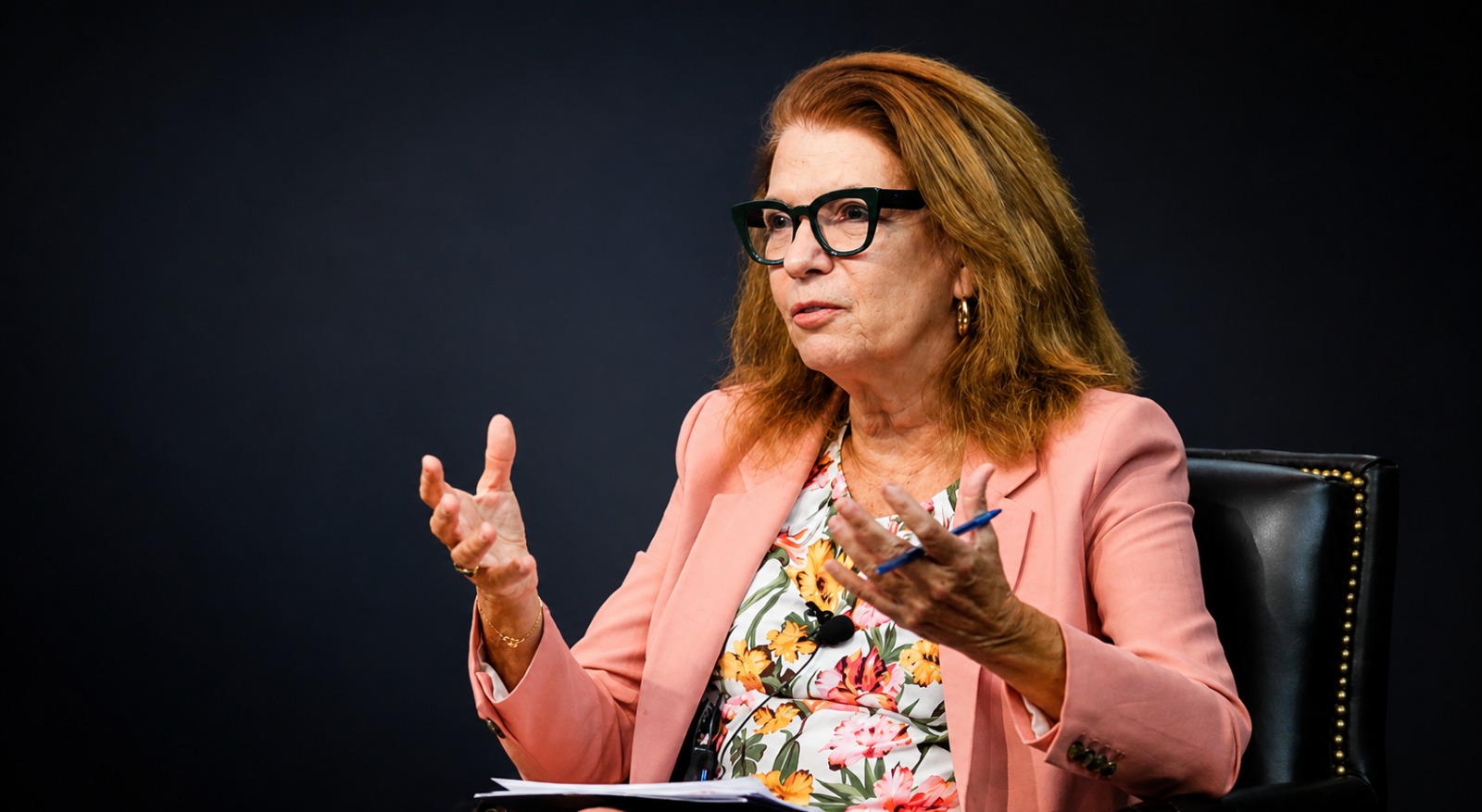
Kornblith: «Han construido el memorial de la corrupción, la cleptocracia, el atropello a los derechos políticos y la censura en Venezuela»
Miriam Kornblith: “You Cannot Tell People That Things Have Changed When They Haven’t”
According to the sociologist and former CNE rector, the accumulated tensions and Venezuelans’ desire to see real change after the events of January 3 will become evident sooner rather than later.
Miriam Kornblith currently serves as Director for Latin America at the National Endowment for Democracy (NED), where she has spent years supporting the strengthening of Venezuelan civil society organizations. She explains that a solid network already exists, one that will help “shape the country that is coming” and raise the necessary alarms to prevent the repetition of the “destructive distortions promoted by Chavismo during this period.”
She also emphasizes that Venezuelan society is “deeply traumatized, yet hopeful at the same time.” However, she believes that healing requires acknowledging what happened and, to the extent possible, providing reparations. “It is not a matter of saying ‘forgive us, get over it, and come back,’ as Jorge Rodríguez put it,” she stated.
Regarding the National Electoral Council (CNE), Kornblith argued that all electoral authorities should be replaced and that the institution’s lower ranks should be reviewed. At the same time, she stressed that Venezuelan society possesses the knowledge necessary to “quickly reverse all the degradation we have suffered in electoral processes.”
—What role has civil society played in building the democratic path that the country aspires to?
They have built the memorial of corruption, kleptocracy, the assault on political rights, and censorship in Venezuela. All of that has been done by civil society organizations, most of which were created during the Chavista era. There is a dense and diverse fabric of organizations that coexist and have been essential in keeping the flame of democracy alive throughout these dark years. They have also been crucial in drawing international attention to what was taking shape in the country.
When Hugo Chávez came to power, the civil society ecosystem was relatively small, but that has changed dramatically over these twenty-seven years. Today, we have a large number of organizations that have become strategic, that feed off one another, and that maintain connections with their counterparts in Latin America and Europe. They even interact with international bodies such as the Inter-American Commission on Human Rights, the International Criminal Court, and the United Nations. In other words, they have become global in their relationships and indispensable in denouncing, reporting, and documenting the imposition of an authoritarian and dictatorial regime in Venezuela.
—In a finally democratic Venezuela, what will this robust network of organizations contribute?
They are agents of change and are already monitoring whether this process of democratic restoration actually materializes. They are proposing reforms that the country needs in order to rebuild its institutions, but more importantly, they reflect a profound reconfiguration within Venezuelan society.
I believe that the State’s inability to fulfill its most basic functions created room for organizations of every kind, and that will lead to a new model in the country, one that is more independent and associative. This social fabric that has been built will shape the next stage, but it will also contribute to dismantling the repressive state and all the distorted institutional structures that still exist in Venezuela.
—Will the documentation and records accumulated over these years become instruments for justice and reparations for the victims of Chavismo?
All of the information gathered on corruption, human and political rights violations, repression, freedom of expression, and so on, will be essential for identifying those responsible. But even more importantly, it will help generate the antibodies needed to ensure that this tragedy never happens again.
There is now a social network capable of raising alarms whenever actions or behaviors threaten the healthy institutional framework that the country seeks to build.
To me, it is remarkable that despite the highly destructive model displayed by Chavismo over these twenty-seven years, so many young people possess deeply rooted democratic values. That is an extremely valuable asset and gives Venezuela special potential, because breaking with the distortions normalized by Chavismo and building a positive alternative is no easy task, yet it is possible in our country.
—Apart from the poorest sectors, which segment of society has suffered the most damage during these years?
More than 20 percent of Venezuela’s population has emigrated. That is devastating and affects every layer of society. But, of course, the poorest sectors have suffered the most. That is the great paradox of Chavismo: it came to power presenting itself as a project of redemption and salvation for the most vulnerable, only to become the worst system of poverty, exclusion, and injustice precisely for those same people.
Society as a whole suffered, but the poorest endured the most terrible experiences. The migrants who crossed the Darién Gap are an example. Then there are specific sectors such as the political opposition and human rights defenders. In fact, the Chavista regime was brought before the International Criminal Court because it committed crimes against humanity against them.
—How can the wounds and scars left by these years be healed?
This is a question that must be answered from many different perspectives. We are a deeply traumatized society, but at the same time a hopeful one, eager to return to coexistence.
It is striking that none of the released political prisoners have spoken in terms of revenge or retaliation. Instead, they have shown remarkable spiritual strength and a willingness to rebuild. They are a moral force for the country and will become examples for those who feel they cannot overcome their pain.
We must also learn from other societies that have endured terrible experiences and managed to overcome them.
But it is very important to recognize that this was traumatic. In other words, it is not a matter of saying, “forgive us, get over it, and come back,” as Jorge Rodríguez said. No. There must be an acknowledgment of what happened in its full dimension.
—Why have international cooperation and institutions such as the NED been important in Venezuela’s democratization process?
International cooperation has a legal foundation. The United Nations recognizes the right of both individuals and organizations to receive support when their own societies are characterized by oppression or by elements that hinder their free functioning.
There is an entire legal framework governing international assistance so that it can counter tyrannical and totalitarian systems.
But for international cooperation to work, there must be demand, and there must be organizations and individuals carrying out activities consistent with the principles underlying international support. In Venezuela’s case, it is telling that when conditions worsened and risks increased, requests for projects and activities also increased.
It is yet another demonstration that, far from being discouraged, people have sought every possible resource to continue fighting.
—Given your electoral experience, what should be done with the CNE?
Well, as things stand today, it is useless. There are electoral authorities who betrayed their oath to defend the popular will. But the positive side is that Venezuela possesses tremendous electoral expertise, both within democratic political organizations and civil society, as a result of years of struggle against Chavismo’s abuses.
Therefore, there are experienced individuals with solid values who could become excellent representatives of a new CNE.
But beyond the urgency of appointing new electoral authorities, the rest of the staff must also be evaluated, and we need to assess how deeply years of mismanagement have permeated the institution. Nevertheless, I insist that Venezuelan society can quickly reverse the degradation suffered in electoral processes because the most important element exists: knowledge.
—How do you interpret María Corina Machado’s forty-week plan to organize a presidential election?
I think it is very reasonable, and what I like most about the strategy is that it places the voter at the center of everything.
I say this because one of the worst things that happened during these twenty-seven years was the contempt shown toward citizens, who are the fundamental electoral subjects. Elections ceased to be a democratic expression and became a terrifying experience, with an intimidating Plan República, hostile polling station coordinators, and the “Red Points” outside voting centers, among other things.
Secondly, there is the distortion of the electoral registry. When I was at the CNE, I chaired the Voter Registry Commission, and I take great pride in the work we did to register new voters and update the rolls accordingly.
With this proposal by María Corina Machado and her electoral experts, the emphasis once again is on ensuring that everyone, both inside and outside Venezuela, can vote. Recent voter registration processes have been a scam, a fraud, and people have had no way to register.
—What are the key points of the electoral calendar that should be presented to the country?
The main priority is to commit the regime to respecting the electoral results. Then, electoral authorities must be renewed, and the voter registry must be adapted so that Venezuelans abroad can vote.
Political parties whose cards have been confiscated and outlawed must also be regularized, and arbitrary bans against opposition leaders must be reversed.
—Economist Miguel Ángel Santos told La Gran Aldea that Washington’s three-phase plan for Venezuela should be implemented in reverse order: first an election, then institutional recovery, and finally stabilization. What is your opinion?
The accumulated tension and people’s desire to see real change after the events of January 3 will become apparent soon, because you simply cannot tell people that things have changed when they haven’t.
Venezuelans see that there have been no fundamental transformations, either politically or economically. I do not know whether the problem lies in the order of the plan or in the way it has been implemented, but it is evident that expectations have not been fulfilled so far.
—Are you optimistic?
Yes, I am, because throughout these years I have witnessed how our society has grown stronger and how deeply rooted our democratic spirit is. That gives me a very positive and hopeful vision for Venezuela.